|
|
How must unbelievers be treated after the Qoran and the sunna? Note 1: I encourage everyone (Moslem like not-Moslems) to enter the debate. Make researches about this. Ask questions to Moslems, imams, unbelievers, about what I say. Note 2: The whole page has not been translated yet. The 9th Sura is the last big sura. It contains the last laws about unbelievers. I's very important to read the whole sura and its tafsirs. At the end of the article you will find the view of the four islamic jurist schools about war. Here you can read the Sura: http://www.harunyahya.com/Quran_translation/Quran_translation_index.php. Here you can find Ibn Kathir's Tafsir for this Sura: http://www.tafsir.com/default.asp?sid=9&tid=20704. Extracts from others Tafsirs for this Sura: http://ourworld.compuserve.com/homepages/ABewley/tawba1.html. Tafsir for the verse 9:5 : This is the Ayah of the Sword Mujahid, `Amr bin Shu`ayb, Muhammad bin Ishaq, Qatadah, As-Suddi and `Abdur-Rahman bin Zayd bin Aslam said that the four months mentioned in this Ayah are the four-month grace period mentioned in the earlier Ayah, (So travel freely for four months throughout the land.) Allah said next, (So when the Sacred Months have passed...), meaning, `Upon the end of the four months during which We prohibited you from fighting the idolators, and which is the grace period We gave them, then fight and kill the idolators wherever you may find them.' Allah's statement next, (then fight the Mushrikin wherever you find them), means, on the earth in general, except for the Sacred Area, for Allah said, (And fight not with them at Al-Masjid Al-Haram, unless they fight you there. But if they attack you, then fight them. )[2:191] Allah said here, (and capture them), executing some and keeping some as prisoners, (and besiege them, and lie in wait for them in each and every ambush), do not wait until you find them. Rather, seek and besiege them in their areas and forts, gather intelligence about them in the various roads and fairways so that what is made wide looks ever smaller to them. This way, they will have no choice, but to die or embrace Islam, (But if they repent and perform the Salah, and give the Zakah, then leave their way free. Verily, Allah is Oft-Forgiving, Most Merciful.) Abu Bakr As-Siddiq used this and other honorable Ayat as proof for fighting those who refrained from paying the Zakah. These Ayat allowed fighting people unless, and until, they embrace Islam and implement its rulings and obligations. Allah mentioned the most important aspects of Islam here, including what is less important. Surely, the highest elements of Islam after the Two Testimonials, are the prayer, which is the right of Allah, the Exalted and Ever High, then the Zakah, which benefits the poor and needy. These are the most honorable acts that creatures perform, and this is why Allah often mentions the prayer and Zakah together. In the Two Sahihs, it is recorded that Ibn `Umar said that the Messenger of Allah said, (I have been commanded to fight the people until they testify that there is no deity worthy of worship except Allah and that Muhammad is the Messenger of Allah, establish the prayer and pay the Zakah.) This honorable Ayah (9:5) was called the Ayah of the Sword, about which Ad-Dahhak bin Muzahim said, "It abrogated every agreement of peace between the Prophet and any idolator, every treaty, and every term.'' Al-`Awfi said that Ibn `Abbas commented: "No idolator had any more treaty or promise of safety ever since Surah Bara'ah was revealed. The four months, in addition to, all peace treaties conducted before Bara'ah was revealed and announced had ended by the tenth of the month of Rabi` Al-Akhir.'' The "Omar Laws" show us how christians and jews were treated in islamic countries. People of the book don't have to be killed, but they are discriminated. I'll copy the Omar Laws here (coming soon).
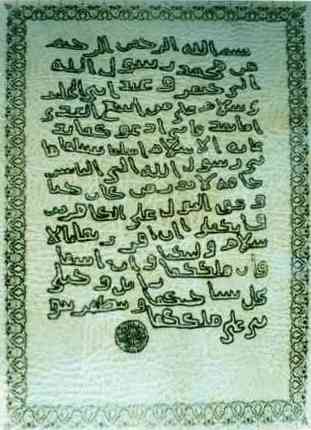
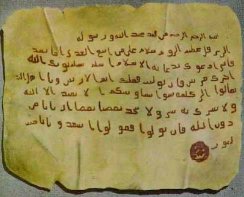
The letter to Heraclius:
Mohammed didn't write that if Heraclius refused islam he would be attacked. Heraclius was to powerful, and it was dangerous to provoke him. So Mohammed hid his purpose. But a refusal would mean a war, like by the oman people. The motives of the jihad (holy war) were summed up by Rib’i ibn ‘Aamir and other companions of the Prophet [an error occurred while processing this directive] (peace and blessings of Allaah be upon him) and were stated to Rustam, the commander of the Persian army, in the battle of al-Qaadisiyyah, when he asked them one after another, for three consecutive days before the battle took place: “What is this that you have brought?” The answer came: “Allaah has sent us to bring forth whomsoever He wills from the worship of people to the worship of Allaah alone, from the hardship of this world to its ease, from the injustice of other religions to the justice of Islam. He sent His Messenger with His religion to His creation. Whoever accepts it from us, we will accept it from him and will go back; we will leave him and his land alone. Whoever refuses, we will fight him until we end up in Paradise or in victory.” The website Islam Q&R has lots of artikels about this: http://63.175.194.25/index.php?ds=qa&lv=browse&QR=27180&dgn=4&ln=eng; for example http://63.175.194.25/index.php?ds=qa&lv=browse&QR=27180&dgn=4&ln=eng. An extract: If verbal discussions and debates, arguing in a way that is better, address deviant beliefs and ideas, then the jihad movement addresses other, material obstacles, foremost among which is the political power that is based on those combined factors. It aims its strikes at the military and political powers that enslave the people to something other than Allaah – i.e., rules them by means of something other than the laws of Allaah – and that prevent them from listening to the truth and following it with absolute freedom. Thus there is a need for both da’wah and jihad in order to face the real obstacles of life. Thus it becomes clear that the basic principle of fighting as prescribed in sharee’ah is jihad, and its purpose is that all religion should be devoted to Allaah, and that the word of Allaah should be supreme. Whoever tries to prevent that is to be fought, according to the consensus of the Muslims. Source: http://63.175.194.25/index.php?ds=qa&lv=browse&QR=27180&dgn=4&ln=eng. The view of the four islamic jurist schools: Malakit school (Ibn Abi Zayd al-Qayrawani): Jihad is a precept of Divine institution. Its performance by certain individuals may dispense others from it. We Malikis maintain that it is preferable not to begin hostilities with the enemy before having invited the latter to embrace the religion of Allah except where the enemy attacks first. They have the alternative of either converting to Islam or paying the poll tax (jizya), short of which war will be declared against them. Schaafit school (al-Mawardi): The mushrikun [infidels] of Dar al-Harb (the arena of battle) are of two types: First, those whom the call of Islam has reached, but they have refused it and have taken up arms. The amir of the army has the option of fighting them…in accordance with what he judges to be in the best interest of the Muslims and most harmful to the mushrikun… Second, those whom the invitation to Islam has not reached, although such persons are few nowadays since Allah has made manifest the call of his Messenger…it is forbidden to…begin an attack before explaining the invitation to Islam to them, informing them of the miracles of the Prophet and making plain the proofs so as to encourage acceptance on their part; if they still refuse to accept after this, war is waged against them and they are treated as those whom the call has reached… Hanbalit school (Ibn Taymiyya): Since lawful warfare is essentially jihad and since its aim is that the religion is God's entirely and God's word is uppermost, therefore according to all Muslims, those who stand in the way of this aim must be fought. As for those who cannot offer resistance or cannot fight, such as women, children, monks, old people, the blind, handicapped and their likes, they shall not be killed unless they actually fight with words (e.g. by propaganda) and acts (e.g. by spying or otherwise assisting in the warfare). Hanafit school (in the Hidayah, vol. Ii. P. 140 ): It is not lawful to make war upon any people who have never before been called to the faith, without previously requiring them to embrace it, because the Prophet so instructed his commanders, directing them to call the infidels to the faith, and also because the people will hence perceive that they are attacked for the sake of religion, and not for the sake of taking their property, or making slaves of their children, and on this consideration it is possible that they may be induced to agree to the call, in order to save themselves from the troubles of war… If the infidels, upon receiving the call, neither consent to it nor agree to pay capitation tax, it is then incumbent on the Muslims to call upon God for assistance, and to make war upon them, because God is the assistant of those who serve Him, and the destroyer of His enemies, the infidels, and it is necessary to implore His aid upon every occasion; the Prophet, moreover, commands us so to do." |